Home Blog Page 94

Facebook Will Make $1.2 Billion Annually From Mobile Ads

No, Facebook is not advertising yet on mobile devices. Yes, that hasn’t stopped people from speculating on what it will mean when it does. The latest: an estimate of how much the social network stands to make from mobile advertising: more than $1.2 billion a year in the U.S. and its five biggest markets in Europe — the UK, France, Germany, Italy and Spain.

The numbers come from UK-based analyst firm Mobile Squared, which has worked out that Facebook will be making an average revenue per mobile user of around $6.50 per year — some $2 more than Facebook currently makes per users online, using figures supplied in its S-1 earlier this month. The caveat here is that the modelling appears to be hinged on mobile display-style ads, while in truth it’s not known what Facebook will do when it comes to formats; and several reports have pointed to them first opting for something altogether different — sponsored stories.

This is how Nick Lane, chief strategy analyst, arrived at these figures:

He estimates that across these six markets, there are a total of 185.3 million users of Facebook on mobile. (That’s something worth noting in itself: Facebook has something of a long tail when it comes to mobile users it seems, with the top six markets still accounting for less than half its 425 million mobile users.)

Within this, the average user spends 12 hours per month on the site, he writes. Here, he notes that comScore puts the average monthly usage at 24 hours.

The average amount of time, he tells me, that a mobile app serves up a new ad is around every 20 seconds, and he puts a CPM on Facebook of $0.25 — calculated, he says, partly based on what other social networking sites are generating on mobile. CPMs, it should be noted, vary wildly — Lane says as low as $0.10 and as high as $50. (Which app brings in that, I wonder?)

The U.S. will account for roughly half of that revenue, at $653.7 million in 12 months, with the UK bringing in $166.6 million, $100 million in France, Germany and Italy, and $70 million in Spain.

He tells me other markets — particularly emerging ones like Turkey, Brazil, and Indonesia — will also add more to the pile, but those CPMs are less stable and were therefore not included in these calculations. He estimates that Indonesia currently has 30 million Facebook mobile users, with another 20 million in Turkey, and 26 million in Brazil.

While it’s worth pondering how much money Facebook could make from mobile ads, there are some big caveats to this kind of number crunching. One thing Lane does not cover are ad formats: the rumors have been that Facebook will first present ads as sponsored stories, rather than traditional display ads, that appear in a user’s timeline. Would these take a different kind of metric other than a traditional CPM and if so, what?

Lane tells me that separate research his firm did for a mobile marketing company found that only 10 percent of respondents said they would be comfortable with brands reaching out and engaging with them through Facebook. Ninety percent said the opposite. If click-through-rates on mobiles is currently 0.5 percent, “expect that figure to drop significantly on Facebook Mobile,” he writes.

There are also still some question marks over what, exactly, the value is of “liking” a brand on Facebook. “Thirty-six million follows, but what does that mean in relation to a brand like Coke?” Lane asks.

Source: MobileCrunch

Vietnam & NASA cooperate in space technology

The Vietnam Academy of Science and Technology (VAST) and the National Aeronautics and Space Administration (NASA) of the US signed a joint declaration on the intention of cooperation in civil space and aviation activities in Hanoi on Dec. 5.

This is the first basic agreement between Vietnam and NASA, opening prospects for cooperation between Vietnamese and NASA scientists in aviation and space research.

Director of VAST National Satellite Centre Pham Anh Tuan said cooperation with NASA will help Vietnamese scientists access and use NASA data sources in Vietnam ’s space technology research.

VAST and NASA will cooperate in the research of space applications for social purposes, the exchange of data on earth research through satellites, environment and geophysics and human resource training for space research, Tuan said.

VAST and NASA will assign experts to implement the framework agreement, he said

Source: VNA

[Survey] Customers satisfied with 3G services in Viet Nam

Most Vietnamese customers said they are pleased with the 3G services of their current network providers, according to a recent survey by market researcher, Nielsen.

At a press conference in Hanoi on Jan. 11, a Nielsen representative said that customers tend to remain loyal to the first 3G provider they register with.


Among 800 interviewed, 41 percent said they totally believe in the future development of 3G services in Vietnam . Sixty-five percent said that 3G technology may replace Internet ADSL.

According to the survey, 3G users are mostly young people, aged from 18 to 34, with an average household income of over 4.5 million VND per month.

The 3G services of the military-run telecom company, Viettel are the most popular in Hanoi and the central city of Da Nang . Meanwhile, the MobiFone network has developed strongly in Ho Chi Minh City , while Hanoi is an important market for VinaPhone.

Popular 3G services include mobile internet, mobile TV and video calls./.

Source: VNA

8 tips for entrepreneurs from a founder-turned-VC

A friend of mine recently asked me a simple question: “After four years as a VC, knowing what you know now, what basic tips do you have for guys like me who are growing venture-backed businesses?” It got me thinking about what I’ve learned being on the other side of the fence – and though I don’t profess to be an expert on how to be the perfect entrepreneur, I thought my own experiences might help some founders out in the trenches today.

1) Keep your options open. The smartest second- and third-time entrepreneurs I see raise capital in a very focused and efficient manner. They preserve option value at each stage of the company’s growth and make conscious decisions about how to proceed in each funding round. I learned this the hard way in my first company, where we raised capital at a $250M valuation and essentially priced ourselves out of an attractive M&A opportunity. I can’t tell you how many companies I see that would be terrific $50M-100M acquisition targets, but lose that option because they’ve raised too much capital.

2) Hire the best talent you can find.  I really can’t say enough about this. The bottom line is A players may cost 50% more than B players, but will add 10X the value. Talent wins. Be proactive and always on the lookout for impact players.

3) Take advantage of the moment, and run like hell. Great entrepreneurs don’t wait. When they’re onto something, they move aggressively, and don’t spend time thinking about Plan B. They realize they have a window of opportunity, and they jump through it. I meet with many companies who are the number two or three player in their space, and the CEO often can’t figure out why the number one player is kicking his/her butt. If I’m doing my job as a VC, I will have also met with the number one player. The leader is aggressive, maniacally focused on growth, moving fast, and delivering for customers. The followers are often bogged down by customer/product/board/funding issues. In short, #1 sees speed bumps and jumps them, whereas #2 and #3 see roadblocks and spend time trying to figure out how to go around them.

4) Work with great investors. This doesn’t necessarily mean the headline-grabbing VCs you read about on TechCrunch. Ever heard of Dave Strohm, David Cowan, or Jim Goetz? They’re three of the most successful early-stage VCs you’ll ever meet, but you won’t typically read about them on today’s hot tech gossip blog. Don’t get caught up in the hype. Focus on VCs who have built winners in your space and reference well with entrepreneurs and CEOs. They’ll make a difference.

5) Play bigger than you are. Create a market impression that is greater than reality. This has to be done carefully – history is littered with companies that failed to live up to the hype – but done well it can really boost your company’s prospects. Artfully tooting your own horn is part marketing, part PR, and part an aggressive approach to today’s social platforms. Done right, Twitter, LinkedIn, and Facebook can serve as powerful platforms to amplify you company’s position. The key is to not just talk about how amazing your company is, but to show how you’re succeeding with key customers, business milestones, analyst and media coverage, and key new hires. Examples of companies that have done a great job building this kind of buzz include Buddy Media, Yammer, Zuora, Betterworks, Square, and Appirio (my firm is an investor in Buddy Media, Square, and Appirio).

6) Find and leverage mentors. There are many amazing CEOs in Silicon Valley who love nothing more than to help young entrepreneurs build great companies – you just have to ask for their help. It’s one of the truly unique aspects of Silicon Valley. Ask your investors for introductions. And don’t just reach out to a mentor in times of crisis; build an ongoing relationship with him or her. You’ll be amazed and the nuggets of wisdom you pick up from CEOs who have “been there, done that.”

7) Be honest and transparent. The most successful entrepreneurs I know are transparent with their team and with their board. They stay in regular communication with their board members and treat board meetings as an opportunity to have a meaningful discussion around core issues – not as a sales pitch. Your board and investors are “in the boat” with you, and fully invested in helping you build a winning company. If you have to constantly “sell” your company to your board members, you’ve got the wrong board members. Brad Feld and Fred Wilson have covered the topic of board meetings well.

8) Enjoy the ride. I started my first company when I was 25, and by the time I was 30 we had raised more than $100M and hired 400 employees. It was awesome, but I was immensely stressed. The second time around, I surrounded myself with better talent, raised less capital, and had a lot more fun (and a better outcome). Great entrepreneurs have that unique DNA that makes them relentlessly focused on building something great, and it’s a 24×7 thought process. However, the difference I see between first-time entrepreneurs and second-time entrepreneurs is that veterans are typically enjoying the ride. They’ve figured out how to make time to have fun, spend time with family and friends, and still build a great company.

I look forward to hearing from entrepreneurs in the trenches. What did I miss? What kind of advice have you valued from your mentors and investors?

Source: V.B

Apple makes iAd more attractive for developers and advertisers

Apple has altered the terms of its iAd agreements in a way that both developers and potential deep-pocket advertisers should find favorable, an Apple spokesperson told VentureBeat today.

iAd is Apple’s mobile advertising network. It places ad spots into iOS apps to generate revenue for the app’s developer.

Apple launched iAd back in June 2010, initially offering developers a 60 percent cut of the ad revenue generated. The company also initially required would-be advertisers to spend a minimum of $1 million per campaign, which was done to ensure that ads on the network were both high quality as well as lucrative for all parties involved. (In other words, no teeth whitening advertisements or click scams.)

Unfortunately for Apple, advertisers weren’t biting, as VentureBeat reported in December.

Yesterday, however, Apple announced new terms for iAd, which included giving developers an additional 10 percent cut of the revenue and lowering the minimum cost of an iAd campaign to $100,000 for potential advertisers, the company has confirmed. Apple said it listened to industry feedback from ad agencies, brands, and developers when restructuring the new terms.

The changes will go into effect April 1, 2012.

Apple said it’s hopeful the revised iAd terms will spark a renewed interest from developers. The new 70/30 percent revenue split Apple is offering is in line with the industry standards, so there’s a good chance more developers will be willing to deploy the company’s ad network on to their iOS apps.

Also, a greater number of advertisers are likely to do business with iAd now that the minimum commitment for a campaign is significantly lower.

We’re guessing the $100,000 minimum is still higher than many other competing mobile ad networks in terms of barrier to entry. However, Apple is attempting to push iAds as a better service and product much in the same waypeople feel justified in spending a little more money on Apple computers.

With more than 550,000 apps on the App Store and 315 million iOS devices sold, the iAds audience should catch the attention of potential advertisers.

Source: V.B

Yelp will start its IPO at $12-$14 per share

Yelp has amended its SEC S-1 filing to show a starting price of $12 to $14 per share of Yelp stock.

The shares will make their debut on the New York Stock Exchange under the symbol YELP.

The most recent amendment to the S-1 form was filed today after the closing bell.

The company initially filed for its IPO back in November. In the deal, the company expects to raise $100 million.

The last time the venture-backed startup disclosed its earnings, net revenue for the first three quarters of 2011 sat at $58.4 million, up 80 percent year over year. That figure breaks down to around $40 million in from local advertising revenue, $12.6 million from brand advertising revenue, and $5.4 million from other revenue sources.

At that time, the company had $23 million in cash and saw losses of $7.6 million for the nine-month period in 2011, lower than the $8.5 million losses posted for the first three quarters of 2010.

Yelp has come under criticism in recent days for its practices with regard to small businesses. In a recent VentureBeat editorial post, contributor Rocky Agrawal blasted the company, calling Yelp advertising a “rip-off” for smaller businesses and saying that the company vastly overcharged its smaller customers by around 1,000 times more than the industry standard.

Agrawal also argued that Yelp’s advertising — a huge part of its revenue — is poorly targeted, meaning that not only are advertisers being overcharged in his opinion, but Yelp is also not delivering the promised results.

We’ll keep you updated with news on the Yelp IPO as the date draws nearer, so stay tuned.

Source: V.B


Viet Nam targets $12 bln in mobile phone exports this year

The annual value of mobile phone and components exports of Vietnam is forecast to reach $12 billion by the end of 2012, according to the Ministry of Industry and Trade.

To meet the target, experts said Vietnamese exporters should attach importance to ensuring the quality of their products, to protect brand names and secure sales.

They should also expand trading to new markets.

By the end of January this year, Vietnam ’s mobile and components export revenue reached $850 million, up 0.8 percent over the previous month’s figure and 113.9 percent over the same period last year.

Sony completes Ericsson buyout

With regulators signing off, we knew it was just a matter of time before Sony’s buyout of mobile partner Ericsson was complete, and it looks like today’s the day. Sony has announced that it has finished its acquisition of Telefonaktiebolaget LM Ericsson’s 50-percent stake in Sony Ericsson, a move that came at a cost of €1.05 billion ($1.47 billion). While Sony has already begun rebranding Sony Ericsson products under its own name, the company also announced that it would be renaming its mobile unit Sony Mobile Communications as part of a larger strategy to unite the company’s various departments under the leadership of new CEO Kazuo Hirai.


Video Plays Mobile Devices Nearly Doubled in Q4

From Redbox and Verizon teaming up to take on Netflix to Connected TV and Netflix’s premier of Lillyhammer, offering consumers video content where and when they want it is no longer just a second thought. Serving content across platforms has become essential for publishers and brands that want to grow their audiences and earn more revenue with online video.

Ooyala, the online video provider, today released its fourth quarter review of web video, in which it analyzes the viewing behavior of 100 million monthly unique users. (You can find the full report here.)

As we learned in Q3, the rabid adoption of mobile devices has been leading to increased engagement with online video. Not only that, but connected TVs are really beginning to make waves, Google TV in particular. Ooyala’s report found that video plays on tablets, mobile devices, and connected TVs nearly doubled in the fourth quarter (from Q3).

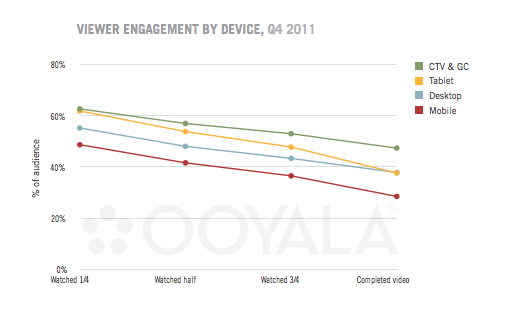
What’s more, viewers are now twice as likely to compete a video when watching on a tablet or connected TV, as compared to watching video on a desktop. And, unsurprisingly, when viewers plop down on their couch in front of their connected TV, they’re watching four times as many long videos compared to short videos, as videos longer than 10 minutes now account for more than half the hours played on connected TVs.

While the average conversion rate across all devices increased from 35.1 percent in Q3 to 39.6 percent in Q4 (with viewers watching longer on all platforms), it seems that connected TVs saw the biggest growth in Q4, as their viewers proved to be the most engaged of all the platforms, completing videos at a rate of 47 percent (with tablet viewers following close behind at 38 percent.)

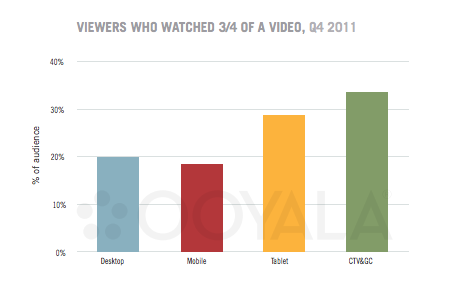
What’s more, users of connected TV devices and gaming consoles were 70 percent more likely to watch three-quarters of a video. And, in terms of name brands in connected TVs, Google TV’s share of video plays increased by 91 percent this quarter.

Tablet viewers were the most engaged in Q3, and they certainly remained an attentive audience in Q4, proving to be 45 percent more likely to complete three-quarters of a video than those watching on a desktop. Not only that, but tablet viewers watched 21.9 percent longer per video in Q4 than the prior quarter.

Another interesting tidbit from Ooyala: Though this may not be particularly surprising, Facebook remains a much more active source of online video sharing than Twitter: For every video shared via Twitter in Q4, more than 10 were shared on Facebook.


Source: MobileCrunch

Apple’s iPhone Stole The Smartphone Show In Q4, 2011

We’ve seen handset makers like HTC, LG and Nokia all warning of declines in smartphone sales. But if there is a slowdown affecting some, it’s not because people are not buying smartphones; it’s because they’re all buying iPhones.

Figures out from Gartner today say that smartphone sales totalled 149 million units in Q4 2011 — 47.3 percent higher than the same quarter a year ago, led by none other than Apple’s iPhone, which its analysts noted “saved” the smartphone market after two quarters of declining sales.

The mobile device market is also getting ever closer to a tipping point in terms of smartphone dominance: Gartner notes that they accounted for one-third of all mobile sales in the last quarter worldwide. The analysts predict that in 2012 smartphone sales will continue their march, growing by 39 percent compared to only seven percent growth for feature phones.

That is significant in that it shows how strong smartphones are playing in developing markets as well. In developed markets like the U.S., UK and Japan smartphone sales have been close to or already outpacing feature phone sales for a little while now.

Platforms. Moving away from specific vendors, Google’s Android platform grew even more dominant, and accounted for more than 50 percent of all smartphones sold, up from 30 percent a year ago. Apple’s iOS and bada from Samsung were the only other two platforms that grew in market share, with the rest all continuing to see big declines, including the Windows Phone platform from Microsoft, which accounted for 1.9 percent of sales.

Apple. On the strength of tremendous iPhone sales in the U.S. and Europe, Apple became the world’s biggest smartphone vendor, with a 23.8 percent share of all sales in Q4, which works out to unit sales of 35.5 million smartphones.

Apple is now also the third-largest mobile phone vendor in the world overall. That’s notable especially considering that the two vendors ahead of Apple, Samsung and Nokia, are also selling a range of much less expensive devices.

But one word of caution to note here, too: Gartner doesn’t expect Apple to have a blockbuster quarter like this again soon — saying that a lot of the boost was due to pent-up demand from consumers awaiting the newest model of the iPhone, which turned out to be the iPhone 4S. Famous last words or the canary in the coalmine?

Losers. More bad news for LG, Sony Ericsson, RIM and the newest charm on Google’s bracelet, Motorola: all saw declines in market share — not only because of fierce competition from Apple and Samsung in mature markets but also because of price pressure in developing markets from the likes of ZTE and Huawei.

The sub-$100 smartphone is only going to become a more prevalent theme in the future, and companies like RIM will have to address that if they hope to claw back some of their old leadership. (Yes, there is an irony here: Apple doesn’t dabble in cheap devices — putting aside handset subsidies that carries put on a range of devices, including the iPhone.)

What of Nokia? Still on top in the overall rankings by a good margin, and not losing nearly as much steam as you would have expected, given all the doom and gloom that gets reported. Its share is now at 23.4 percent compared to 27.1 a year ago. Indeed, in its last quarterly earnings, Nokia actually showed quite good results for sales of its feature devices, even as it saw huge smartphone declines. Samsung inched up a couple of percentage points to 19.4 percent of all sales — a testament to its strong Android-based smartphone sales and its equally strong line of feature phones built using its proprietary bada OS.

Source: MobileCrunch